

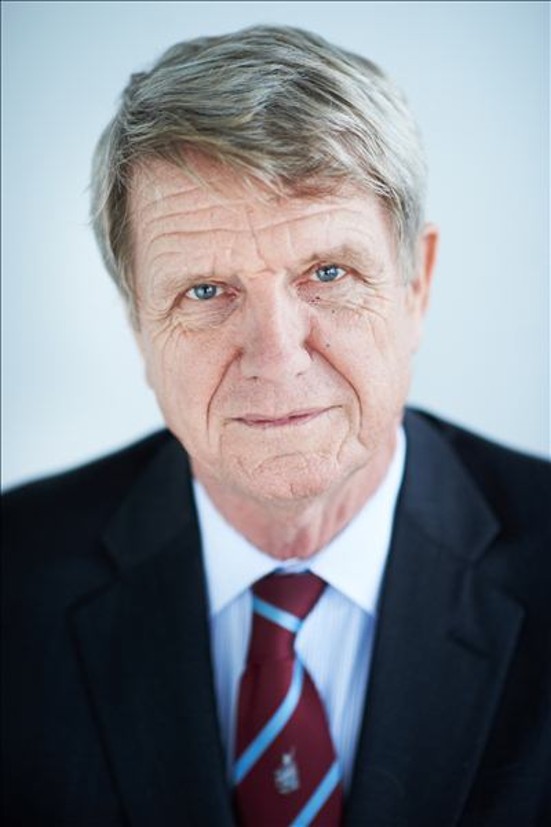
YOUTH
Where does the name Hoyng come from?
It's not a very common name; it comes from northern Germany. Around 1850, my great-grandfather emigrated from there as a sixteen-year-old boy, with three brothers: he went to the Netherlands, two went to America, and one went to Chile. I believe there is still a bakery called Hoyng in the city of Vechta in Lower Saxony. If you google it, you will find a Hoyng who is active in intellectual property law in America. All Hoyngs are ultimately related. Every 25 years, there is a family reunion attended by Hoyngs from Germany, America, and Chile. I have been there twice now. Over time, the name has become quite widespread in those countries. The family is originally Catholic. Catholics had many children in those days. This was also true of my great-grandfather, who had nine sons! The youngest son was my grandfather. My great-grandfather had started a chain of stores called Hoyng. The older generation still remembers these as luxury stores where you could buy beautiful items for the home, such as lamps, tableware, etc. When I was five, I was allowed to open the store on Kalverstraat in Amsterdam. That didn't go so well, because I was given the scissors in my left hand! I couldn't cut the ribbon. My mother ran forward and gave me the scissors in the right hand!
My grandfather's brothers did not want their youngest brother, my grandfather, to join the business. So in 1903, they bought a pottery factory in Gouda for him, which later became the Royal Plateelbakkerij Zuid-Holland2. Gouds plateel is painted and glazed decorative pottery from Gouda, and in the municipal museum Gouda you can still see a few pieces that were made in that factory. So my grandfather was involved in pottery. My father practiced the same profession and studied at the Keramische Hochschule in Germany. My grandfather had a motto: "pottery is horse work." That's why I didn't aspire to that profession! I was born in Gouda, but at some point, my father went to work for the Sphinx in Maastricht, and that's how our family ended up in Maastricht. I was twelve at the time. For the last two years of elementary school, my parents sent me to boarding school because I spoke with a strong Gouda accent and they hoped that boarding school would correct that somewhat. In Maastricht, I went to the Stedelijk Gymnasium. As a boy of about ten, I was sometimes allowed to accompany my father to the factory when a cart with pottery was stuck in the kiln because the pottery had fallen off. My father may have been the deputy director, but he would lead his men into the kiln in asbestos suits to get things back on track. Exciting to see as a young boy, but certainly not something that made the profession appealing.
Up until fifth grade, everything was going very well. After that, things went downhill. I was an avid sportsman, played a lot of tennis and soccer, and had to repeat the fifth grade. That wasn't such a disaster, but the following year I failed my final exams. I was a science student and had three nines for math, but also a five for Greek and a five for Latin, when I should have had at least a six and a four. At that time, there were still state commissioners, and they refused to give me those grades. Unfortunately, I had to repeat the sixth grade. That was annoying, because in those days you had to do military service immediately afterwards. I did pass my final exams the following year, with two sixes for Greek and Latin and slightly lower grades for math!
How did military service go?
I always wanted to study medicine. I had said so during my military medical examination, and that is why I joined the medical corps. Between my final exams in June and the start of my military service in November, I worked in a concrete factory and hitchhiked through Southeast Europe, including what was then Yugoslavia. In the second week of my military service, two men in gray suits (I later understood that they were from military intelligence) came and asked me what I had been doing there. I said that I had been looking around and had visited Belgrade and Zagreb, among other places. It was the time of the Cold War. They asked me who I had spoken to and whether I had taken any photos, and then they left. Two months later, we received "political education" at the barracks. I asked (and perhaps I shouldn't have!) why De Waarheid, the Dutch communist newspaper at the time, was not allowed to be read at the barracks, even though I could buy it at the kiosk down the street. A few days later, two men in grey suits came back and asked me why I had asked that question! I may have been a bit annoying during that conversation: I said that I found it strange. After that, I didn't make a career in the military! Most people with a high school education became non-commissioned officers or officers, but I ended up as a private first class. Anyway, I did receive good training in first aid, which I used to save someone's life at least once. I also got my commercial driver's license, which allows me to drive buses and trucks for the rest of my life.
And then you went to college.
Yes, in Leiden. I was 22 and started studying law in October 1968. Most of my friends were already studying. As I said, I wanted to study medicine. My father had said that I could study, but that I hadn't achieved much so far. He therefore allowed me to study, but he would only pay for one year. If I didn't pass, I would have to go to work. So I decided to study law, because my friends said it was the easiest. Of course, I partied during my first year, but I worked really hard for exams because I wanted to pass. I finished my first year with four nines on my report card. I even received a book voucher for the best first-year exam. I didn't spend that book voucher on books, but on drinks! I realized that it wasn't such a big deal, and that gave me confidence. Unlike many others, I also enjoyed studying. I remember the Roman law course taught by the world-famous Professor Feenstra3. There were more than 300 people in the first lecture, 80 in the second, and 12 in the third. I was one of those twelve, and I found it a really interesting and enjoyable course. In hindsight, law was a choice that appealed to me.
Why Leiden?
That was at my father's insistence, who felt that if I wanted to study law, I absolutely had to go to Leiden. There was no room for discussion. So I ended up in Leiden instead of Maastricht. That was quite unusual. After all, almost everyone from my high school and circle of friends in Maastricht went to Nijmegen or Tilburg. The harsh Dutch atmosphere did not appeal to the southerners, but I was an 'imported southerner' because I had lived in Gouda until I was twelve. My father also said that I had to become a member of the Leiden Student Corps Minerva, and I did so without question.
After the first year, I took all the rest of my exams within two years and graduated in just under three years, in September 1971. I had noticed that if you put in a little effort, the exams were fairly easy to pass. I was also quite active in the Leiden Student Corps. In my third year, I was also "Commissioner Hifi." Hifi was a well-known student discotheque, which I had renovated and made more commercial.

At that time, the corps and the women's association VVSL were still single sex, but not the disco! That appealed to young people of that age. Moreover, we had a license until four in the morning, which was also attractive. A lot of money was made with that disco. Strictly speaking, only students were allowed to come, but there was a tacit agreement between the officials who monitored compliance with the licenses and a dozen men from the Leiden underworld that they could also come: they had money, spent a lot, and didn't cause any trouble. I ran this disco until a month after I graduated.
Did you also come into contact with IP law during your studies?
No, never! At the beginning of my second year, I was given an assistantship with Prof. Van Esveld4, in social law. After my bachelor's exam, I taught seminars to master's students who had chosen that as an elective. And why am I telling you this? Because Van Esveld was located in the same part of the Gravensteen5 as Prof. Haardt6 , the man who taught industrial property.
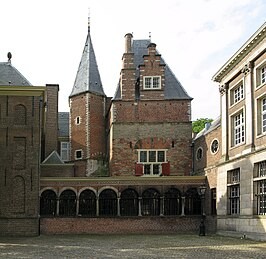
The Gravensteen in Leiden, Erik Zachte, Creative Commons.
However, I did not take IP as an elective either. I graduated with a thesis entitled "Legal aid as social insurance." I had calculated it all: that people would pay a certain low premium throughout their lives and that you would then always have legal aid through such a public insurance scheme, instead of the combination of publicly funded legal aid and private legal expenses insurance that we still have today. I did that with Prof. Haardt, because he also taught procedural law. Haardt apparently thought it was pretty good, because he sent my thesis to Kluwer and indicated that it might be interesting to publish. Kluwer was working on a book about legal aid. A few months later, I received a package from Kluwer thanking me for the interesting thesis. I received a Deventer cake as a gift. Unfortunately, the subject had already been chosen by someone else. I found that somewhat strange, because the subject was quite original. But anyway, that's possible, of course. When I read that piece afterwards, I knew at least one thing for sure, namely that Kluwer had given my thesis to the author. However, this incident did not inspire a love of intellectual property in me either!
Did you experience any student unrest during your time as a student?
No, that passed us by in Leiden. There was one occupation of the administrative center. Pro Patria7, Minerva's student defense association, i.e., the sub-association for defense enthusiasts, took action once, as far as I know, and cleared the building. People talked about it a bit as if it were shameful. But it was nothing compared to Amsterdam. I never experienced any lectures being cancelled or any problems. In Leiden, it wasn't really a thing, certainly not at Minerva and not at Augustinus, the Catholic student association, either. Of course, I read about it in the newspapers, but that was it.
What did you do after your studies?
After three years, I was done, but all my friends were still studying, because at that time, a law degree took at least five years. I enjoyed staying in Leiden and applied for a job at the Civil Law Department, where I was hired at the same time as Hans Nieuwenhuis8 . Hans and I started on the same day, in October 1971, I think. At the time, the position was called research assistant, which was a well-paid job back then. The first thing I heard during the job interview was that there was no room available and that I would have to work from home. Eventually, Hans and I were given a room at the top of Rapenburg 38, where the Civil Law Department was located. I taught seminars, mostly to my own classmates. One of the best students in the privatissimum consumer law course, which I taught together with Ewoud Hondius9 , was my future colleague at De Brauw Constant van Nispen! Teaching seminars to doctoral students was not easy for me at first, because how had I studied civil law myself? I wanted to study quickly and had therefore never opened an Asser book, but I had studied Prof. Stein's summaries10 and got an eight with that alone. But of course, to teach a seminar, you have to know the prescribed material, and that means the Asser Series! So I had to work damn hard in those early days. Everyone knows that teaching means you have to understand the material more thoroughly; you have to be a little above it, really. Some very serious students asked me questions about topics that weren't on the syllabus until weeks later. I always told them we would get to that and that gave me some breathing room. That's how it went the first year. As a result, I did gain a reasonably good knowledge of civil law.
I worked in a group with some very interesting people, such as Joan De Wijkerslooth11 (later state attorney and professor), AW Kist12 (also became state attorney and the first director-general of the Netherlands Competition Authority), Hans Nieuwenhuis (later professor and judge of the Supreme Court), Anita Biegman-Hartogh13 (later Advocate General at the Supreme Court) and Bart Groen (later professor and state attorney), with Prof. Bloembergen14 and Prof. Kleijn15 as professors. Every two weeks we had an academic meeting where someone talked about what they were working on, and you learned a lot from that. It was a wonderful, educational time.
Another little anecdote, because that's where I experienced my first kind of legal battle.
Under the influence of the student movement, the University Administration Reform Act 1970 (WUB) had recently been introduced, and Article 40 WUB gave students the opportunity to appeal against a grade. One of my club friends took the Constitutional Law exam and received a five. I was just in my first year as a research assistant. He came to me, showed me the question and his answer, and said that he didn't think his answer was wrong. He had read the question differently than the examiner had intended. I thought his reading was certainly plausible and, in that reading, his answer was correct, but the examiner did not want to change his grade. I then drafted an appeal for him under Article 40 WUB. That's when things got interesting. The appeal, which also bore my name, was submitted to the Constitutional Law Department, headed by Tijn Koopmans, who later became a judge at the European Court of Justice16 . He called my boss, Bloembergen: "Listen, it can't be right that one of your research assistants is now going to fight us over an exam, can it?" Bloembergen replied that he didn't see why this shouldn't be possible and that it would be a good learning experience for me. He told me that I could go ahead with the case, but that I had to express myself politely. Then there was a hearing before a committee chaired by Haardt and including another professor, two research assistants, and a student representative. That was actually the first time I had ever argued a case. The decision was that the five was incorrect, that the answer should be counted as correct, and that the student should receive a six. In addition, the Constitutional Law Department was advised to give a six to other students who had received a five and had given a similar answer. The Constitutional Law Department did so, and eight students were given a six. That was my first experience arguing a case, coming up with arguments, etc. It has stayed with me a bit. All in all, it turned out well!
I had also written an article in Intermediair about misleading advertising and had spent two years working on a book by Bloembergen about traffic accident victims and their injuries, for which I interviewed 40 people who had been severely disabled as a result of traffic accidents. (I had taken a course for this purpose). Bloembergen's idea was to move towards a system similar to that in the Canadian province of Saskatchewan, in which civil liability no longer plays a role in payments by (public) insurance. I wrote a chapter about this. Those interviews were harrowing and really opened my eyes. On the one hand, you saw people who had been hit by a car due to a moment of inattention on their part, and who therefore received nothing at all and had to fall back on social assistance, and on the other hand, you saw people who had been hit by a car through the fault of a motorist, and who received a lot from the insurer. When you realize that we all make mistakes in traffic, these enormous differences are often the result of random circumstances and therefore unjustifiable. After that, I fully supported Bloembergen's idea, especially after I had interviewed these people and seen how terrible the consequences of traffic accidents can be. I also once wrote something about the right to light and view, a wonderful subject! So I didn't just continue my student life.
LAW
How did you become a lawyer after that?
One of my club mates said at the time: you shouldn't get stuck in that stuffy university environment. You can't spend your whole life at university, can you? Go and talk to my brother. That was Wybe Taekema17 , a lawyer at Blackstone, Rueb & Van Boeschoten, who recently passed away. One evening, I went to see Wybe at his apartment somewhere in Mariahoeve, The Hague. I'm not a big drinker, but I still got pretty drunk during that long evening with Wybe. I woke up in the morning with a headache, but I knew there was only one thing I really wanted, and that was to become a lawyer, and only at one firm, namely Blackstone, Rueb & Van Boeschoten. Wybe got me excited. He told me about the legal profession, about cassation appeals, and about the firm itself. There was a vacancy, I applied, and was then interviewed by Mr. Blackstone, Mr. Martens18 (later president of the Supreme Court), Mr. Van Boeschoten, and Mr. Enschede. At the time, you still used formal language with everyone and said "sir." Yes, it was a very serious job interview, the kind that I don't think would be possible today. It wasn't unfriendly, but it was a serious discussion about the law, in which you were challenged considerably. I was able to start in the cassation practice because Blackstone and Martens needed support.
I remember the first day well. I am a morning person, and I arrived at 8 a.m. That seemed like a good time to start, but for the average lawyer, it is too early. I arrived at the same time as Mr. Van Haersma Buma, one of the senior partners, who was also a kind of handyman for the office. He replaced broken light bulbs, built cabinets, and so on. He asked me what I was there for. When I said I had been hired as a trainee lawyer, he told me to come upstairs with him. He gave me a cassation file and said, "Let me know if you think the court got it wrong."
Before the 1970s, we were a large firm with about sixteen lawyers. Every morning at 10 o'clock, we would drink coffee together in the library. Mr. Blackstone sat in the middle of the table and asked if there were any problems. If someone had a problem, as the youngest, you knew what was going to happen: you would be the first to answer the question. It was quite a tough learning curve, but those discussions about law and trial strategy were extremely instructive.
The same applied to languages. They believed that you had to be proficient in modern languages. We had a client that I hated: the Danish embassy, which gave all claims from Danish companies against Dutch companies to Rueb, who immediately passed them on to the young people. Letters to the Danes had to be written in German. I did learn German at secondary school, but writing a letter in German without mistakes is another matter entirely, and it had to be flawless. Such a letter would be returned with every line underlined in red. "Try again and see if you can do better," they would say. That's how I learned German. The atmosphere was great, but we worked very hard. We also worked on Saturday mornings, and you didn't really ask for holidays during your internship.
How did you come into contact with IP law?
After I had been working there for about six months, Mr. Blackstone said that Mr. Schaper19 could use some help. He dealt with industrial property, as did Blackstone, but mainly with cassation cases. He said that Schaper was very busy and asked if I would like to work for him. Nowadays, an intern might say that they had been hired for the cassation practice, but at that time you just didn't say that, and I said I was happy to do it. So I started working for Schaper and that's when I really came into contact with industrial property. As I said, I had never studied intellectual property law in Leiden. I hadn't had any particular interest in it, but at Schaper I immediately loved it. The technology, but also the brands, and what I really liked was that it wasn't as stuffy as the cassation practice. There were summary proceedings, which I loved.
I was lucky, because the Centrafarm cases were being heard in Luxembourg at the time, so I landed on my feet. We argued a number of them in Luxembourg20.
I quickly realized that the most interesting time for a young lawyer is when the partner is on vacation, because then you have to take over the practice and you are allowed to advise on cases yourself. I did have to check in with Mr. Rueb, but he was fine with it. And so I handled my first preliminary relief proceedings, against Van Nieuwenhoven Helbach, of De Brauw & Helbach21, another predecessor firm of what is now De Brauw Blackstone Westbroek, but at the time a major competitor. It was a trademark dispute over Boldoot, and I will never forget that case because I was in my third year. I wasn't really modest: I was polite, but I had a fairly big mouth. After the pleadings, Helbach said, "Kid, you did a good job!" I will never forget that, because it was also a lesson for me, for when you are older and you have young people in front of you: it's okay to compliment them when they've done a good job. That is a huge encouragement for a novice lawyer. Incidentally, he lost the case, and his client had to discontinue the TV commercial.
In 1976, I was told that I needed to improve my English. Ellen Timmermans (later President of the Criminal Division of the District Court in The Hague) said I should try to get a scholarship from the British Council, which I did. With that scholarship, you could go to England for six months, the first two months of which were spent at Kings College for an introduction to English law, followed by two months with a barrister and two months with a solicitor. My firm gave me six months' leave, arranged everything, and continued to pay part of my salary, so I was treated well. It was a special time. In 1975, the UK had just joined the European Economic Community. For my solicitor internship, I ended up at Linklaters, where I was asked all kinds of questions about European law. I knew quite a bit about that, after the Centrafarm proceedings. During my barrister internship, I also experienced proceedings with the Queen's Counsel who handled IP within the chambers. It was an educational and useful time!
Was that when you met your wife Marie-Claire?
That's right. She studied international law in France, which included a three-month course in English law at Kings College, where we ended up in the same class. And yes, that's how it happened. So not only had my English improved, I had also found the woman of my life. At first, we communicated in English. My French wasn't very good, but I picked it up fairly quickly. When things got more serious, I started visiting my in-laws, where French was spoken. After graduating in Aix-en-Provence at the end of 1976, Marie-Claire came to the Netherlands, and after three months she was speaking Dutch fluently! She's a real language person, much more so than I am!
And then back to Blackstone.
In 1978, after celebrating New Year's Eve in Aix, I returned to the office in early January and Rueb came up to me and said: congratulations, you've become a partner! That's how it was back then, which was quite fast for that time. Two weeks later, I had my first partners' meeting. Van Boeschoten handed out a note and said, "I propose that this be the profit distribution for the coming year." Everyone agreed. I never signed anything. I also received a share of the profits. It was quite reasonable, but compared to today, it wasn't that much. Later, when we merged with De Brauw & Helbach in 1990, everything became more official and time recording was introduced. But we didn't know that at the time. You sent an invoice at the end of the case. Because no time was recorded, the file was weighed up by hand and a reasonable (actually far too low) amount was arrived at. When we started tracking time and billing quarterly, we suddenly started earning twice as much and became a bit more commercial. Before that, we practiced law because we enjoyed it. Not that you didn't earn anything, but from the 1990s onwards, it became more lucrative. We worked hard, but everyone enjoyed it. We had a partner who was smarter than the rest and was more interested in chess. He played chess more than he worked, but no one ever said anything to him about it. You can't imagine that happening at all in today's world.
After that, you worked at Windsurfing International for a while.
Yes, that's right. I had been working with Schaper in the IP practice since the 1970s and got on very well with him. I still go out for dinner with him about twice a year. He is now 93 and still sharp as a tack. I remember that he and I organized the first meeting in Zeist. That is still the annual IP highlight in the Netherlands. He was active in the AIPPI, he was chairman, and under his leadership, the AIPPI congress was organized in the Netherlands. The Dutch section of the AIPPI, the VIE, still benefits from this, because it made a profit of almost a million guilders.
Schaper did business for the Dutch company Ten Cate, which sold windsurf boards in Europe under a patent and trademark license it had obtained from Hoyle Schweitzer, the inventor of the windsurfer. His company, Windsurfing International, had filed patent applications in England and Germany, but not in the Netherlands. In order to keep competitors out of the Dutch market, Schaper showed the court attractive videos of windsurfing to illustrate the fact that Windsurfing's boards were protected by copyright. At one point, Schaper told me that I should handle the preliminary relief proceedings. There was some tension between Ten Cate and Windsurfing International, and negotiations were sometimes necessary. I was allowed to do that, so I went to America from time to time. I then noticed that the way Windsurfing International handled its patents in Europe was not good. That was important to Ten Cate, because it had a license relating to the English and German patents, and the German market in particular was very lucrative. Until 1978, the copyright protection of the Windsurfer in the Netherlands was going well, but then I was involved in an appeal case at the court in Amsterdam and when I entered the courtroom, I already knew what was going to happen, because Gerbrandy22 was sitting in the room. He naturally thought: how ridiculous is it that you can protect an invention with copyright? So after that, it was over. Of course, the Windsurfer brand was also hopeless, so I advised that it was far too descriptive and could be used by anyone. In any case, you have to run campaigns where you come up with a generic word and then introduce that generic word. I came up with the word "sailboard" and then there was an advertising campaign: "Windsurfer, the world's first sailboard," or "The best sailboard," or " Ten Cate's sailboard." In French, we came up with "planche à voile." Unfortunately, someone in Germany had already registered the trademark "sailboard." Then we had "Stehsegelgerät." But that's not a very appealing generic name, of course! Eventually, Schweitzer said to me: "You always say that we're not doing well with our patents, and I'm also having problems in America, Japan, and Canada: would you like to come and work for me?" I said that I couldn't because I worked for Ten Cate and that would create a conflict of interest. Schweitzer was disappointed and said that it would also be good for Ten Cate if I came to work for him, because then everything would be better organized for them too. He then called the CEO of Ten Cate behind my back, who then called me to say that Ten Cate was fine with me going to work for Windsurfing International. But of course I was still a partner at the office and told Schweitzer that I couldn't just leave for two years. After asking what my hourly rate was, which was about 200 guilders at the time, he wanted to hire me for two years at that rate. I then went to my partners and told them about this unique opportunity for me to go to America, with payment at my hourly rate. I thought it was an educational opportunity and was looking forward to it. There were patent issues in Japan, Canada, South Africa, America, etc. My partners agreed to the two-year arrangement.

In 1981, Marie-Claire, our first child Anne-Claire, and I left for Los Angeles. I had negotiated with Schweitzer that our family could return to the Netherlands twice a year. I have never travelled in such luxury since: KLM 1st class, with a bar above. All of that has now been abolished. You boarded the plane, I handed my 1½-year-old daughter Anne-Claire over to the flight attendants, and for the rest of the flight we had free time. My son Alexander was born in America and is therefore American. Marie-Claire also worked there. She had also studied art history and worked at the Getty Museum. That was also a fantastic experience. For me, it was a very educational experience. You are in a company and see how they view what lawyers do, etc.
I then tried to solve the problems I had identified earlier. I was often in Japan and spoke to many American lawyers. In Germany, it was very exciting, and the highest court ruled that the patent in question had been granted correctly.
I also handled a competition case for the European Commission23. It concerned a license agreement whereby you had to pay a certain amount for the entire product. That agreement had been drawn up before my time by American lawyers who based it on the patent as granted in the US. But in Germany, the patent was only granted for everything above the shelf, so a complaint was filed with the European Commission. In the end, everything worked out well, mainly because we successfully amended the agreements so that instead of 7.5 percent on the entire product, 17.5 percent had to be paid on the mast, sail, and universal joint. The revenue remained the same!
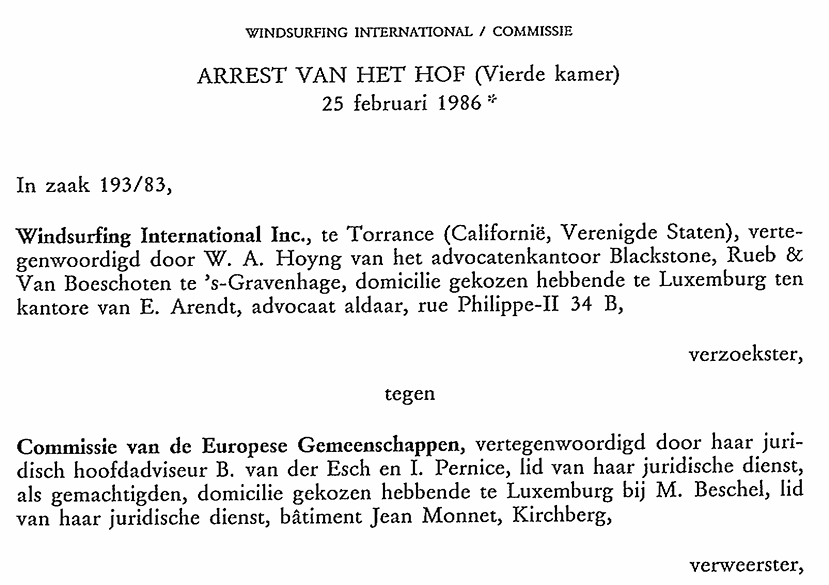
I negotiated and granted licenses. The potential licensees were usually wealthy young Germans in their thirties who also wanted to manufacture and sell sailboards. I invited them over, preferably to Hawaii, because Schweitzer had a vacation home there and then, of course, those guys would have terrible jet lag. The night before, we would go out, and the next morning, the negotiations would begin. That usually worked out well for us... In addition, we had a system where we would say: you are going to belong to an exclusive club, so we first have to negotiate the entrance fee, and only then the royalty. So, first, a hefty base amount was paid, and then a royalty was paid that was also in the double digits. Schweitzer, who was initially very difficult about granting licenses, eventually gave me free rein. He also made a lot of money from it and ended up in a beautiful house in Bel Air in Hollywood, among the movie stars.
We also had a problem in the run-up to the 1984 Olympic Games in Los Angeles. The International Yacht Racing Union, which organized the windsurfing competition, had chosen a German board, made by Ostermann24. It wasn't very widespread, but of course the International Yacht Racing Union also included all the Eastern Bloc countries, and they absolutely did not want an American board. Ostermann had also sent his board to all those countries free of charge, so it was chosen as the Olympic board. I then wrote a letter to the organizers of the Games, stating that this was not possible because it would infringe our patent. There was a court case in New York, in which Ostermann and the organizers asked the judge to grant a kind of compulsory license in this special situation so that we would not invoke our patent during the Olympic Games. We won that case. I then negotiated with the IOC and Ostermann, and we eventually agreed to allow the board to be used in exchange for a large sum of money, on condition that we were allowed to hold a demonstration event with our own Windsurfer during the Olympic Games. With a Windsurfer, you can sail fast, but you can also jump and do other cool things ("freestyle"), so in the end, everything worked out and with this Schweitzer also made money.
After two years, the American office that handled our patent cases asked, "Why don't you stay here? Take the California Bar Exam and come work for us." They offered a decent salary, and living in California was very pleasant. We lived in Pacific Palisades, where the terrible fires recently occurred. The climate was fantastic. So I would have liked to stay, but I felt I couldn't do that to my office. After all, I had said I would return after two years. Linklaters also asked me in 1976 if I wanted to join them, but again I felt I couldn't do that to my office, which had continued to pay part of my salary.
You also obtained a doctorate.
In 1984, Jan Vranken25 joined me in my room atas a trainee lawyer. He had obtained his doctorate and wanted to gain experience in the legal profession. He did that for three to four years and then became a professor in Tilburg. Just like before with Hans Nieuwenhuis in Leiden, it was of course a privilege to share a room with Jan. Not only because of their extremely pleasant personalities, but also because they were both truly brilliant lawyers. I realized time and again that I couldn't match them, which prevented me from getting carried away (after a minor success in court). At one point, Vranken said that they were looking for a professor of IP and that I would be a good candidate. But I didn't have a PhD, and in Tilburg you can't (rightly) be appointed as a professor without one. "Okay," I said, "I'll do it."
But what subject should I choose for a dissertation that I could write alongside my practice? During my windsurfing days, I was often confronted with questions such as what happens if you only sell the sail, or if you sell the sail and the wishbone, but not the board? I had actually thought quite a bit about that parts situation, and I thought it would be a nice little topic. That thought led me to the repair of machines. There were two Supreme Court rulings26. "That's manageable," I thought, and I started my dissertation in January 1987. During the spring break, I sent my wife and children to France and asked Maurits Barendrecht27 to take over my practice for two weeks. I worked really hard during those two weeks and by then I had basically finished the framework, which I continued to work on. I did the same thing for two weeks during the summer vacation. I also worked on the dissertation in between: I got up at 5:30 every morning and worked on it until 8:30, because I had already noticed that it doesn't work in the evening if you've been working all day; you don't feel like it anymore and you don't have the energy for it. After about ten months, it was finished, and I asked Jan Vranken if he would be my supervisor and sent it to him. We discussed it, and after some good tips from him about the structure, it was ready.
That's when Helbach came back into my life for a while. My partner Jan van Arkel said: if you want to have it read by a real IP expert, why not ask Piet to do it? But he was a competitor - not an enemy, because we were good colleagues. Most of our IP cases were with Blackstone against De Brauw, and things got pretty heated in court. So I asked for his help. And Helbach said, "Yes, of course, send it over." After a week, I was able to visit him. He said it looked fine. He disagreed with me on one point. We discussed it and remained in disagreement! Helbach was then on the doctoral committee, which is exciting, of course, because you get to answer questions. That's when you see the goodness of the man, because his question was precisely about the point we had discussed for an hour. That was a piece of cake because I knew all about it!
I obtained my PhD in January 1988 with a thesis28 and became a professor on April 1, a position I enjoyed for 35 years in Tilburg!
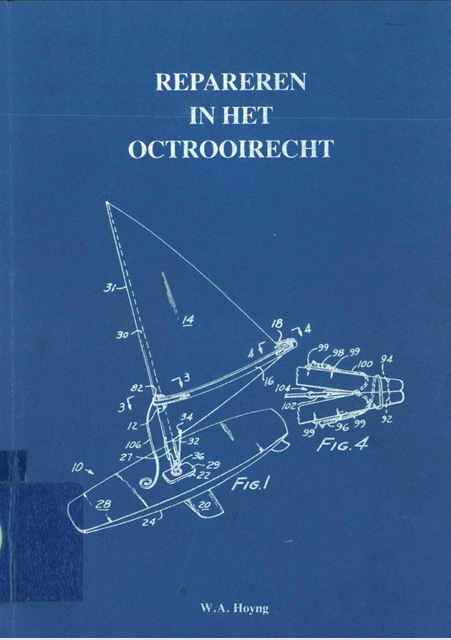
That dissertation begins with an anecdote about visiting a farmer who wants to repair his tractor: did you make that up?
Yes, partly. That was inspired by the cases I handled for the company Vredo, an interesting Supreme Court ruling, incidentally, about when a judge in summary proceedings can say that a case is too complicated29. A specialized judge cannot say that too quickly. I changed the names slightly, but in such a way that the insiders would know who I was referring to; the case, on the other hand, was largely fictional. My intention with that anecdote was to indicate that it was a book written by a practitioner, without too many scientific pretensions.
I remember another time when I was sitting there early in the morning thinking about what it would actually be like to put an infringing machine in a Museum of Modern Art. Would that constitute infringing use of that machine? Yes or no? Those kinds of terrible twists kept coming to mind. I kept thinking that I wouldn't be able to finish it within a year if I started thinking and writing about that, so there are quite a few things I didn't discuss that you could still discuss. More something for a PhD student at university who has four years to complete their doctorate, without a busy law practice! In the end, it still ended up being quite a few pages.
After your appointment as professor, the merger with De Brauw & Helbach took place.
At the end of the 1980s, there was a major wave of mergers. We were approached by many of the Amsterdam and Rotterdam firms (Dutilh, Nauta, Nolst Trénité, Loeff). I had indicated that Loeff was by far the best partner, because they had no cassation practice and had no IP practice at all and offices in Rotterdam and Amsterdam but nothing in The Hague. However, Loeff had a system whereby a number of partners were a kind of super-partner who earned more than the rest, the so-called rainmakers. I remember Taekema saying during the partners' meeting: "We can't merge with them. I find the way they operate so unethical that it shouldn't be allowed." Half of the partners agreed, so we wrote off Loeff. In the end, we merged with De Brauw & Helbach. But that was a completely illogical merger from a business perspective: the gentlemen in The Hague knew each other and had somewhat similar ideas and respect for each other's quality. But then again, we both had a thriving IP practice, both had a thriving cassation practice, and both had a small office in Amsterdam. It was actually an illogical choice. If you had looked at it from a business perspective, you might have done things differently. But in the end, agreeing on core values proved to be important and it turned out to be a success.
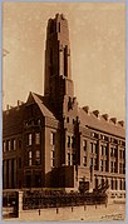
The Red Elephant, formerly Petrolea Office Building, NAi collection, photographer unknown, Creative Commons license.
How did it work out, suddenly sharing an office with your main opponents?
It actually went very well. We had weekly IP meetings. We tried to resolve conflicts as much as possible before the merger. For example, we had Procter & Gamble and they had Unilever. We were able to keep both. Of course, it's not always easy (even with clients) to reach agreements, but in the end it went quite well. I have to say that I moved to London soon after the merger, which I'll talk about in a moment. Schaper suffered a bit because of that, because I abandoned him again, but just like when I left for LA, he never held it against me. The IP partners at Blackstone and De Brauw respected each other. We were also able to complement each other: for example, we had Van Nelle as a client, who indicated that if they had a case where they needed a street fighter, they would come to me, and in other cases where that was not necessary, they preferred to go to the more posh Stoop at De Brauw (laughs).
Did Blackstone and De Brauw mainly represent rights holders?
That's right. I've been accused of that before, but of course we were more concerned with defending the rights of the rightful owners, and that has always been the case. That's also because that's how it has developed in practice. That doesn't mean, however, that we didn't act on behalf of those without rights; we did that too. I would like to remind you that I fought against Lego's monopoly on behalf of Mega Brands all the way to the Supreme Court30, and I would also like to point to Van Bentum/Kool31, where Van Bentum was a small transport company, and to my fight for parallel importer Voorbraak against Ciba Geigy. The best cases are those for the little guy who is in danger of being crushed by the big guy. I recently handled another case like that, where they tried to bluff someone out of court by invoking patents, copyright, etc. So I am certainly not just a lawyer for multinationals. Of course, it was sometimes difficult that we had the same kind of clients. I had handled cases against, for example, Unilever and Van der Lely, clients of De Brauw, in which I had been quite aggressive during my closing arguments. I was young at the time, and Blackstone called me on the carpet about it once. I had argued that it appeared that Van der Lely obtained its patents by taking photos of competitors' new products at agricultural exhibitions, making some changes to them, and then applying for patents. That was obviously going too far. In the end, everything worked out and both companies even became my clients until I eventually left De Brauw and chose Procter & Gamble. I can only say that the atmosphere at the new office was good.
And then you went to London for that merger office.
In 1991, De Brauw entered into a partnership with a number of European firms: Uría Menendez in Spain, Boden Oppenhoff in Germany, De Bandt van Hecke & Lagae in Belgium, and Jeantet & Associés in France, forming the "Alliance of European Lawyers." These firms wanted to establish a joint office in London. At De Brauw, no one really wanted to go to London. I did, but I had little knowledge of banking and finance and had to learn about it. Marie-Claire also wanted to go to the UK.
I then spent six weeks in Amsterdam taking a crash course in banking and finance. I had indicated that I was willing to go to London, but that I wanted the two best associates from that practice. They turned out to be Francine Schlingmann and Julie Roelvink, two fantastic associates. I looked for office space and set up the business. I also did IP practice in the Netherlands and flew to the Netherlands to handle summary proceedings and such. The nice thing was that we worked in London with one colleague from each office, so it was very international. The office ran very well and I worked there for four years. Marie-Claire then studied landscape architecture at Merrist Wood College. After the first year, she received first prize for achieving the best exam results. She did that for three years and really enjoyed it there. The same goes for the children. The boys played soccer and rugby, and all three of them learned English through play, of course. After returning, we decided to live in France so that the children could attend the Lycée International near Paris. That is a French high school with a Dutch department where you also learn Dutch at the high school level, so that you can subsequently study at a Dutch university.
When we returned, De Brauw had an engagement with Loyens & Volkmaars (now Loyens & Loeff), and they wanted us to have offices in all the places where they had offices. That was too much for De Brauw, of course, and the compromise was that we would open an office in Eindhoven. Once again, no one wanted to go there, but I was fine with it. I had seen that there was a flight between Eindhoven and Paris: on Mondays I worked from home, and the other four days I was in Eindhoven and stayed at Hotel Campanile, a simple hotel. We worked in a small team consisting of a notary, a candidate notary, and a few lawyers. By then, I had a fairly substantial practice and needed an employee who knew something about IP. You joined us through a headhunter, Frank, and you were willing to commute between Amsterdam and Eindhoven for a while. More than 25 years later, we are still working together.
Then came the move to Howrey.
The Eindhoven office was doing very well, but after a while it became clear that a partnership with Loyens & Volkmaars would come to nothing. So I went with you, Frank, to Amsterdam to build up the IP practice there. Lokke Moerel was the only IP partner there at the time. Bart van den Broek and Joris van Manen then moved from The Hague to Amsterdam. Ultimately, we had a wonderful IP practice there! During that time, I also commuted between Amsterdam and Paris, or Toulouse, to our home in Gaillac. For example, I helped my son Stefan with his math assignments via fax.
In the meantime, the Alliance of European Lawyers had become Linklaters & Alliance.
At some point, the question arose as to whether we wanted to merge with Linklaters. I was in favor of it, because I had always wanted an international firm, partly because IP is international. But apparently there was a certain fear within De Brauw that London would call the shots, and that fear was not entirely unjustified. An Englishman was in charge of all practice groups, except for the IP practice group, where I was in charge together with Jeremy Brown. In the end, the partners at De Brauw decided not to merge, which I found particularly unfortunate. I then tried to give our IP practice international appeal in another way and suggested that our IP group could at least collaborate with IP firms abroad or form a combination. At first, the IP partners were positive, but in the partner meeting, one of them changed his mind completely. That was the end of the international dream, and I was done with it.
A few weeks later, Howrey approached me with a request to visit them. They said they had an office in London and wanted to expand it with litigators of different nationalities. I told them that wouldn't work. If you want to be serious, you need to have an office in the important countries and hire the best litigators there. I said I would only do it if Bart van den Broek came with me. Bart was (and is) a guy after my own heart, 100% loyal, a super hard worker, and a top IP litigator. What's more, he was twenty years younger than me. I was 57 at the time. I first checked whether Bart wanted to come along and then spoke to you, Frank. I then told Howrey that I wanted to start an office in Amsterdam first, and that we would take it from there. And so it came to pass. Carreen Shannon, now Legal Director at ASML, also came along, and so the four of us, along with our secretaries Annelies and Marisa, started up in Amsterdam. I then found people in Paris, Brussels, Munich, and Madrid, and the London patent attorneys eventually moved to Amsterdam, along with David Owen, an American lawyer and patent attorney.
Why did you decide to start your own business?
We were greatly affected by the very strict American conflict rules in Europe. Not only the ethical conflict rules, but also the commercial ones, whereby clients agree that your firm can only serve one client per sector. So: only one pharmaceutical company, only Coca Cola and no other soft drinks, and in the case of Budweiser, not only no other beer brands, but no other alcoholic beverage manufacturers at all. That all goes very far and we are not used to that in Europe, and certainly not in the Netherlands. In addition, there was little synergy with the American practice. The partners there had wonderful clients, but it was very difficult to get work from them. The result was that we brought more work across the ocean than we got back from there. Although we earned well, we exported substantial amounts of money every year and, ultimately, after the sudden death of two important partners, we no longer had much confidence in the management. In short, we began to realize that the transatlantic IP practice we had dreamed of was not easy to achieve.
How did you get started?
We drew up a plan and discussed it with our Belgian and Spanish IP colleagues at Howrey, whom we considered to be good people: they were in favor. I felt that our German and French colleagues were less compatible in terms of vision, and perhaps also in terms of character. This was not the case for our Parisian colleague Denis Monégier du Sorbier, and when I heard that he had decided to start his own firm with his wife, I brought him on board. So we started with the French, the Belgians, and the Spaniards. We were then missing Germany, but we eventually solved that by merging with Reimann Osterrieth Köhler Haft, which had also started as a niche firm a few years earlier. The question then arose as to whether we should also include England, Italy, and, for example, the Scandinavian countries, but we have always said that you should only merge if you are truly convinced that the merger partner delivers absolute first-class quality, which is why we have stuck with this approach so far. In England, they also have a very different approach to practice than we do. There, firms thrive on a number of very large cases, while we also have medium-sized cases and therefore work less in teams of ten to fifteen people. We were one of the first to come up with the idea of a European IP firm that also employs patent attorneys, and I think our European footprint has also helped enormously with the transition to UPC practice. Based on our experience with conflict rules at Howrey, we didn't want any Americans involved, so it didn't become a global firm.
How does setting up your own firm work?
Actually, given our practice, particularly in Europe, I was confident that it would work and, given all those conflict issues, even better than at Howrey. I must say that confidence was largely fueled by the excellent team we had in Amsterdam. Without Bart in particular, but also the others, including the patent attorneys, it would not have been possible. When things became more concrete, I discussed our plan with Howrey's American managing partner, and I was able to make good agreements with him about taking over people and office space. So the practical side was not that difficult.
Things did not turn out so well for Howrey after that. We were quite important within the firm because we were very profitable: after we announced our departure, others left as well, and a few months later the firm went bankrupt. I understand that no one suffered any damage as a result, because all creditors were paid.
From that moment on, we have been what we are today. We moved to one of the top floors of the Rembrandt Tower and are still there. A European niche IP firm, with a strong soft IP team and our own patent attorneys. The latter has the great advantage of having the technical expertise in-house. In the past, some 20-30 years ago, patent attorneys and law firms were really separate. That worked fine, but with your own patent attorney, I think you can be a bit more honest with each other. I am quite outspoken, and then you don't have to watch what you say for fear of not getting any more cases. The move to in-house patent attorneys was quite a big step at the time, but now everyone at our firm is convinced of its usefulness. In the field of soft IP, we also have both an advisory function and a litigation practice: the latter is real legal work.
CASES
Do you have a case that you have bad memories of?
I am reminded of a case from a long time ago: Heetman/Baileys. A Dutch beverage manufacturer had made a copy of the Baileys label, and Heetman marketed it in the Netherlands. We represented Baileys and initiated summary proceedings in Rotterdam, just before Christmas. When I arrived with the bottles, the bailiff said in thick Rotterdam dialect: "Well, they look pretty similar." I thought: "Indeed, everyone can see that." I went through the usual trademark spiel: that you shouldn't compare the products side by side, but rather the image that sticks in people's minds, that Baileys was the best, advertising, etc. My opponent, an attractive young lady whom I didn't know from the (then still small) IP world, took the floor and said:
"I think it's great what Mr. Hoyng has to say about trademark law, but to me it's actually quite clear: if I want to buy a bottle of Baileys, I'm not going to come home with a bottle of Heetman, am I?"
And that was her argument. The judge said: "Yes, Mr. Hoyng, I think there's something to that." I tried a few more things, but the judge said: "Do you want a verdict, Mr. Hoyng? We will issue a negative verdict in the new year." I asked for a verdict, the judge set the verdict for January 6, and it was indeed negative. I was pretty pissed off, because I thought it was simply infringement. I appealed to the court of appeal in The Hague and, to cut a long story short, there were three older gentlemen sitting there, the lady did exactly the same thing, and I lost again. I then appealed to the Supreme Court on behalf of Baileys, because I thought it was wrong. "Similarity" is, of course, quite factual, so I had tried to twist things around so that the Supreme Court could look at it. And yes, the opposing counsel was the later vice president of the Supreme Court and your former editorial member Ernst Numann32, who was still a cassation lawyer at the time. AG Franx agreed with us, but the Supreme Court found it all factual and I had to leave33.

A funny case?
I am reminded of an incident involving court president Henri van den Biesen in Almelo. On a Friday afternoon, I had a preliminary relief proceeding against Peter Hendrick, who was still with Stibbe at the time, later Freshfields: he was from Amsterdam and I was from The Hague. We had started at two o'clock in the afternoon, we were busy pleading, and at four o'clock Van den Biesen suddenly said: "Okay, stop gentlemen, we'll continue on Monday." We looked at each other in surprise, because we would have been finished within half an hour. As we walked out, we asked the bailiff what was going on, and he said, "But you know that Mr. Van den Biesen always goes to the club for his weekly drinks at four o'clock on Fridays, don't you?" Of course, we didn't know that from Amsterdam and The Hague, but in those days, the president of the court was the boss, and they were quite colorful characters.
I am also thinking of the Philips/Navcom case concerning navigation systems. The EPO had helped patent applicant Navcom because he had gone to the Board of Appeal himself, but the patent he ultimately obtained was simply invalid; in my opinion, that was 100% clear. After convincing my client Philips that this would be the cheapest solution, I tried to settle, but that didn't work and Navcom started infringement proceedings. Her lawyer had pleaded the case, and I wanted to present my pleadings in response, but the president said: "Yes, Mr. Hoyng, you may argue your case, but you don't have to." There you are, with your 30-page pleadings: what do you do? I then said, "If you think that it will not contribute to the case, then I will remain silent." And the claims in summary proceedings were dismissed. I don't think you see that kind of thing anymore these days.
Your fondest memory?
I like to think back to the Voorbraak/Ciba Geigy case. Voorbraak, a family business, was a parallel trader in pesticides. About three years earlier, it had lost an infringement case brought by Ciba Geigy against it with another lawyer, resulting in a ban on parallel imports from France. In the meantime, the Court of Justice had ruled in the Centrafarm cases that this was contrary to Community law, but Voorbraak had not lodged an appeal. When the owner told me about this, I advised him to claim damages in proceedings on the merits, because I thought the preliminary injunction decision was simply wrong. Owner Voorbraak said, "Okay, well, if you say so, go ahead." I started the case and unfortunately lost it in the first instance. Then it was:
"- But you said it was such a strong case?
- Yes, I still think so, you should appeal.
- Yes, but what about the costs?
- Don't worry about that, we really have to appeal."
We appealed and then added to our case that the French parallel patent had since expired. We won in court for the period during which there was also patent protection in France, but lost for the period after that. The client was satisfied, but Ciba Geigy appealed to the Supreme Court. I then lodged an incidental appeal to the Supreme Court with regard to the period during which the patent had expired in France. We won that case too34. In the end, Voorbraak received something like 1.5 million guilders.
I started working with that owner in the 1970s and then worked for his children, and then again for his grandchildren, until they sold the company for a good price.
That ruling effectively introduced strict liability. In my opinion, you cannot simply say strict liability, because I have always understood that this must be based on a legal provision, but if you look at how the Supreme Court phrases it, that is what it boils down to: if you have won summary proceedings, you threaten enforcement measures, and afterwards the patent is invalidated, then you are simply left hanging. Later, we got Article 9 of the Enforcement Directive, which, in short, stipulates that in the event of provisional measures that prove to be unjustified, the court may, at the request of the defendant in summary proceedings, order the plaintiff in summary proceedings to pay appropriate damages. Recently, some uncertainty arose in this regard following the Bayer Pharma ruling35, but this was recently rectified with the Mylan/Gilead ruling36. In my opinion, it follows from the latter ruling that Ciba Geigy/Voorbraak is still valid, as long as there is a possibility to take all circumstances of the case into account.
The blowing up of the protection for the Lego brick was, of course, also a nice case. That case concerned slavish imitation. In a 1999 ruling, the Amsterdam Court of Appeal had ruled that competitor Lima had not distanced itself sufficiently from Lego bricks, because Lego successfully argued that it was possible to sell suitable bricks that were not identical, for example by making holes in the side37. In a later case, Mega Brands asked the Breda District Court for a declaration that it was allowed to market its compatible bricks in the Netherlands. The court followed the Amsterdam approach and ruled in Lego's favor. They appealed to me, and I submitted a survey to the Court of Appeal in Den Bosch in which I asked people: "If you want to buy Lego for your children or grandchildren, would you also consider buying these types of bricks?" The survey showed bricks with holes in the sides. And yes, the vast majority of people said they would not want to, because it would not fit in with the Lego bricks. I based my argument on this: "How can you build a wall with bricks that have holes in them and bricks without holes?" Well, apparently I convinced the court with that argument, and in short, it ruled that Mega Brands was allowed to market bricks that were adapted to the dimensions and appearance of Lego and Duplo bricks on the basis of a need for standardization among the public38. During the plea, I also noted, as a bit of a tease, that Mega Brands was also allowed to use the word Lego, because it had become a generic name. The Lego people turned completely pale, but I advised Mega Brands not to wage that war. We then also won the case in cassation39.
Decades earlier, I had come up with something similar against Adidas, assisted by my colleague Stoop. My client sold soccer shoes for novice soccer players with three stripes, and I had conducted a survey among boys aged 5-12 (girls' soccer was still virtually unknown at the time). The result was that a shoe without three stripes is not really a soccer shoe. I then argued that it was necessary for a manufacturer to have three stripes, especially if he wanted to sell to those novice soccer players aged 5-12. Adidas had become a little nervous, and after some pleading, we managed to reach a nice settlement. Some time ago, I assisted H&M in cassation. My good friend Gino van Roeyen had defeated Adidas in the court in The Hague after a battle lasting many years over two stripes. We managed to uphold that in cassation40.
A recent case that I look back on with pleasure is that of Menzis/AstraZeneca: after AstraZeneca's patent for quetiapine was invalidated, health insurer Menzis claimed damages because it felt that for years it had had to reimburse excessive prices for what, in hindsight, was an unjustifiably patented medicine41. This caused quite a stir in the pharmaceutical world, because it involves a lot of risk: you start summary proceedings and win, but then the patent is invalidated and you not only have to reimburse the generic manufacturer that you kept off the market, but also all kinds of health insurers? And who knows what other people might be involved. That was rejected, which was an important victory. It was striking that the court, by ordering two hearings, tried to force AstraZeneca into some kind of commitment or compromise, even though in my opinion it was really clear that Menzis had to lose, especially given the way they had conducted the proceedings. Then the court came up with the finding that there had been unjust enrichment, but that was rectified by the court of appeal. I wonder whether it was a wise choice for Menzis in this case to be represented by a firm that does not have any real patent law specialists. In this case, you could have put forward better arguments than the popular ones that the pharmaceutical industry is guilty of evergreening. In my opinion, as a non-specialist, you should not want to deal with specialist matters.
More generally, I fondly remember the cases I handled against Peter Hendrick, whom I mentioned earlier. Those arguments against him were often more like comedy, he was so terribly witty. I already mentioned the Van Bentum/Kool42 case. We lost in court. Peter's client Kool was nevertheless willing to discuss a settlement, but Van Bentum did not want that: "I enjoyed those pleadings so much, I want to see them again, on appeal!"
PATENT LAW
One of your pet subjects is the essence of invention43.
That's true, but I would rather say: the patented inventive concept.
Anyone can kick against the doctrine of the essence, but when it comes to explaining a patent on the basis of its description, or to equivalence, it is almost impossible not to wonder what the invention actually consists of. What is this invention really about? And you will find that reflected in all kinds of formulas that we use. The American standard for equivalence, for example, is: "essentially the same result in essentially the same way with essentially the same means." The word "essential" says it all: it's about the "essence," in other words, the essence. I think it's nonsense that you can do justice in a patent case without answering that question. I have always referred to the "patented essence." If you apply for a patent that is too limited and end up with a poor patent in which you have not captured the essence, so to speak, then you have a problem. The Interpretative Protocol to Article 69 EPC actually says it too: one must find the right balance between the two extremes described there, combining fair protection with a reasonable degree of legal certainty. And what is that, fair protection for the patent holder? Surely it is that he is rewarded for what he has contributed to our knowledge? And what is that, in turn? Well, it is precisely what the invention is all about. The reverse is also true, of course: if someone literally infringes the claims but makes no use whatsoever of the inventive concept, then the patent has been granted too broadly and there should be no question of infringement.
I therefore still believe that this is certainly a good point of view to take into account when interpreting a patent, and that when you talk about legal certainty for third parties, these are not naive third parties who know nothing about patent law, but "persons skilled in the art," assisted by a (good) patent attorney or lawyer.
How do you look back on cross-border practice?
I had previously attempted, together with my colleague Teartse Schaper, to obtain a trademark injunction for Philips lamps in several countries, but I believe I am the first to have attempted this in patent law. My thesis already contained a footnote44 on this subject. The following year, I brought summary proceedings against Toon Huydecoper45. That was in The Hague, for Brinkhof46, and I represented Monsanto against DSM, which subsequently became and remains a valued client. I wanted to obtain an injunction for both the Netherlands and Belgium. Brinkhof asked me:
"Yes, but Mr. Hoyng, is that possible?
- Yes, just look at the EEX Convention.
- What about the nullity?
-You can assess that for the time being, and Article 16(4) of the EEX Convention does not stand in the way of that."
He asked Huydecoper what he thought about that. I will never forget his answer. Toon said: "Mr. Hoyng is absolutely right on that point, but we are not infringing."
He won on the grounds of non-infringement47.
During the same period, I conducted a series of preliminary relief proceedings against Stork, which was represented by Jan van Arkel. In one of those cases, I obtained an injunction from the District Court of The Hague against Stork to prevent it from exhibiting a product at a German trade fair48. I believe that was the first case in which a cross-border injunction was granted in a patent case. It led to a very interesting cross-border practice, partly due to judges (such as Willems and Brinkhof) who were open to creative ideas.
I also once handled a case between two Dutch nationals concerning an infringement in America, and I felt that this should also be possible. I had brought the case before the court in The Hague, which ruled that it did not have jurisdiction because the Dutch defendant accused of infringement in the US was based in the district of Den Bosch49 and the exclusive relative jurisdiction of the court and court of appeal only applied to Dutch patents or European patents that are valid in the Netherlands50. A rather uncreative interpretation. So I went to the court in Den Bosch51. I won't forget that either. At the hearing, there was a judge who had worked incredibly hard, knew the entire case file and had looked at American law. Unfortunately for him, it never came to a judgment because we settled the case.
Initially, people abroad viewed these cross-border injunctions with great surprise, because they believed that patents are national rights, which is of course a correct assumption in itself. After the first rulings in the 1990s, the British in particular became very angry and started claiming that we in the Netherlands were practicing cowboy justice.
I subsequently handled two cases on this subject before the Court of Justice, namely Roche/Primus52 and Solvay/Honeywell53. In Roche/Primus, things went wrong because the Supreme Court had stated in its referral decision that each defendant only commits infringement in its own country. Incidentally, in my opinion, that was a scandalous ruling, because the Court of Justice overlooked Article 69 EPC, read in conjunction with the last seven words of Article 2 EPC, which stipulates that the European patent shall have the same effect and be subject to the same provisions in each of the EPC member states for which it is granted as a national patent granted by that member state, unless this Convention provides otherwise (my emphasis). During my pleadings, I expressly referred to these last seven words, which were omitted from the Report to the Court of Justice, but the Court of Justice simply ignored them. This subsequently attracted a great deal of criticism. I believe that a cross-border injunction should be possible against a defendant who is domiciled in the country where you are seeking that injunction, because then he is before his own court. If there is sufficient connection, this should also be possible against co-defendants who, for example, belong to the same multinational. Isn't that how it works when a Dutch court requires a Dutch defendant to comply with a contract to which different law applies? Or if I am sued in the Netherlands for a traffic accident I caused in Germany?
We now eagerly await the ECJ's decision in BSH/Hausgeräte, and then the UPC.
We distinguished ourselves from French and German lawyers in these matters. When you discussed it with them, they always said it couldn't be done because it had never been done before. I would respond that if you never try, you'll never know if it can be done: at worst, you might be proven wrong. In the Netherlands, we have a somewhat different, more creative mentality. Once people started trying it abroad, it turned out that many judges were not very enthusiastic about it and were more conservative than Dutch judges.
Do you have any other examples of this?
That's how Schaper started with recall orders (the "Schaper orders"). I came up with a variation on this because in practice, recalls were sometimes not carried out, supposedly because shops and other customers refused to return the goods. I then had a group of students buy infringing products that were still in the shops to prevent further infringement, and the infringer then had to reimburse the purchase price and the students' costs, for example €50 per purchase. I also once demanded on behalf of a client that certain sentences in a rectification to be published in the newspaper had to be printed in a striking color. That's not nice for the other party, because it costs a lot of money, but no separate defense was put forward against it, so it was granted. The law is something to play with after all!
THE UPC
How did the UPC project come about, after the Community Patent Conventions of 1979 and 1985 had been allowed to die a slow death?
It started with an initiative by the European Patent Office in 1999, in which the Netherlands was also involved, known as the European Patent Litigation Protocol. A working group was set up to draft a concept for this, including former Dutch judge Jan Willems, who had since become a member of the EPO's Boards of Appeal. At the end of 2003, the working group presented its draft, but in 2007 the European Parliament's legal service advised that the EPLA (the word Protocol had since been replaced by Agreement) would be in breach of the EU Treaty54. Meanwhile, at the end of 2006, European patent judges and lawyers had adopted a motion at the Venice Conference calling for the establishment of a central dispute resolution system for European patents. That motion was the result of consultations in a group consisting of a judge and a lawyer from each of the three large countries and myself, in the days leading up to the conference. That was the trigger for Europe to take action. Attention then turned to so-called enhanced cooperation, the possibility of entering into more far-reaching cooperation within the EU structures with only a number of Member States in a specific area55. Italy and Spain kicked against this, but they were unable to stop it. It was complicated to properly regulate the relationship with the European Union. In its Opinion 1/09, the Court of Justice of the European Union ruled that a UPC should in any case be able to refer questions to the Court of Justice when it concerns a question of EU law, but then the British immediately said that the Court of Justice should not rule on infringement and nullity. This led to the system we know today, with a combination of EU regulations and a UPC agreement that is outside EU law. Germany delayed the entry into force of the system for a long time due to various constitutional complaints, but it eventually came into effect.
Do you think that the restrictions imposed by the ECJ in Roche/Primus on cross-border practice still played a role in this?
No, I don't think so, because everyone thought it was strange what the Dutch court did with those injunctions. Not every European court agreed with that; many judges didn't want to go along with it and found all kinds of procedural excuses not to do so. Ultimately, it is desirable to regulate that issue at the international level.
How did you become involved in that project?
I was one of the co-founders of EPLAW and was also its chair for two years. In that capacity, I was also involved in the initiative that led to the annual Venice Conference. I had written quite a bit on the subject and joined a group of three judges and three patent lawyers from the major countries to ensure that it wasn't entirely a party for the major countries. We not only drafted that motion, but also worked on the principles for what later became the UPCA. After that, the Ministry of Economic Affairs asked me if I would like to represent the Netherlands on the drafting committee for the Rules of Procedure, which had the same composition, and later, if I would like to become a member of the Advisory Committee. The latter is remarkable in itself, because the other members of that committee are almost all very experienced (former) patent judges, so with my background as a lawyer, I was a bit of an odd one out. When a chair had to be elected, the Swedish member nominated me (much to my surprise), and that is how I was elected. The election was for three years and expired at the end of February 2025, but on the proposal of my Italian colleagues, I was unanimously re-elected for a new three-year term.
The Advisory Committee plays a fairly important role within the UPC structure: we make recommendations for the appointment of judges to the Administrative Committee, in which the member states are represented. A judge cannot be appointed without our recommendation, and for me, quality is paramount. We are also asked for advice on all kinds of matters. So far, all our recommendations have been followed to the letter, resulting in a Court of Appeal that, in my opinion, is made up of very good judges.
The United Kingdom will ultimately not be participating in the UPC, but we still see many influences from English law in particular in the UPC's rules of procedure.
We spent many Saturdays and Sundays with those seven experts to draft the Rules of Procedure. The starting point for those Rules has always been that you should be able to enforce a patent within a reasonable period of time; in fact, it was said from the outset that you should have a decision within a year. That has now changed slightly because the deadlines for the submissions have been extended slightly compared to what we had originally envisaged, but you should still have a decision within 14 months in any case.
One of the points raised by the British was the oral hearing, which can extend over several weeks. As a group, we felt that you have to be practical and that this is not possible, and it was decided that an oral hearing should in principle not last longer than one day. Hearing witnesses and experts is, of course, an English influence: the Germans want nothing to do with it, and neither do we in the Netherlands. We ultimately opted for a moderate approach, in which the judge is in charge and there can therefore be no cross-examination lasting two days: the judge must only allow relevant questions, and in principle it must all be possible within that one day. Another point made by the British is the distinction, , between the "judgment" and the "order": first, you establish in a "judgment" that there has been an infringement, and then you issue an "order" with injunctions and prohibitions.
But there are also plenty of non-British influences. Take, for example, the French-derived juge rapporteur, who is responsible for the progress of the case. Another influence from the continent is the exchange of written documents, but not in the German way, where you can bombard each other with written documents until the last minute, but in the Dutch way, albeit with two exchanges of submissions. I believe we should also introduce this into our national procedure, just as we have the juge rapporteur, who is involved in the case from the outset. In the Netherlands, the disadvantage is that judges have not read anything until the pleadings. If a conflict arises between the parties, they almost always say that it will be decided during the pleadings.
So you see the influence of all countries, but it has become more of a continental system. In practice, questions sometimes arise and it sometimes turns out that certain things have not been regulated, but in general the Rules work well and questions are resolved satisfactorily by the Court of Appeal. The biggest problems still concern our Case Management System. Such a system naturally has its teething problems, but unfortunately it is not limited to that. In mid-July 2025, we hope to replace it with a more efficient and user-friendly system. When you look at the number of cases, currently around 700, you can really call it a success, and you see that people who opted out are now often regretting it, because it is a good and efficient system with excellent judges.
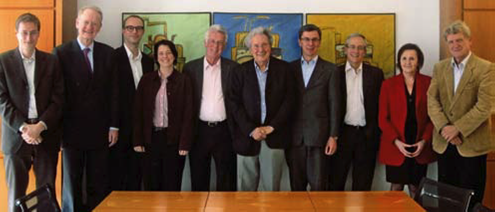
The Drafting Committee of the UPC Rules of Procedure, with audience members
Are you in favor of the Netherlands having the option, as Germany and France do, for example, to convert a European patent that has been declared invalid by the UPC into a national patent?
Yes, I am in favor of that. We are competing with these countries, so we must offer the same opportunities as they do. In practice, however, I don't think it will make much difference, because I can't imagine that you would be able to uphold such a Dutch or German patent nationally if it had been invalidated by the UPC. Perhaps offering that possibility was initially more of a political move to persuade people to accept the UPC, but now that it exists in those countries, I don't see why we shouldn't do it. We currently still have the rule that a Dutch patent expires insofar as it is covered by a European patent. That rule would then disappear, and the Dutch patent would simply continue to exist and therefore remain valid, even if the European patent or the unitary patent is invalidated by the UPC56.
PATENT LAW
What do you think of patent law in the Netherlands?
Perhaps we should start with the Supreme Court. It has no interest in patent cases. I understand that, because they already have so much on their plate. That's why I still don't understand why we don't focus on the most important cases and introduce a leave system. You could say that the legal profession has a filtering function, and we do have Articles 80a and 81 of the Law on the Judicial Organisation (RO), but the current overburdened system can also lead to very unsatisfactory outcomes. I would cite, for example, the landmark ruling by the Court of Appeal in The Hague on standard essential patents: in cassation, the Supreme Court dismissed the case by invoking Article 81 RO, which means that we do not know how our highest court feels about this issue, even though it would be important in a European context57. I criticized this in my farewell speech, but recently the same thing happened again in the internationally important Apixaban cases, after a thorough and extensive opinion by AG Van Peursem58. Very unfortunate. I am also thinking of my last plea before the Supreme Court, in the water balloon case59. I thought the court's decision was really wrong when it came to applying file wrapper estoppel. You could say, as AG Van Peursem does, that the assessment of what a third party might think when reading the grant file is factual, but with that decision we are completely out of step with the rest of Europe, and one cannot expect the Supreme Court, which has no time and no real patent specialists, to do anything about it. Worse, of course, is that when AG Van Peursem, who is a specialist, finds two grounds for appeal in one of the Philips cases, the Supreme Court rejects the appeal, partly on the basis of Article 81 RO and partly on the basis of reasoning that is completely incomprehensible60 to me. Now that there is no longer a real patent specialist in the Supreme Court since Numann's departure, I think you could also consider giving the specialized court the final say in patent cases, but as I said, I think the Supreme Court should deal with far fewer cases, and only those that really matter.
As far as the Court of Appeal in The Hague is concerned, it is particularly unfortunate that both judges Blok and Kalden have left for the UPC. This means that a great deal of experience has been lost, and I am very curious to see how the court will continue without these two experienced members.
I was also not particularly enthusiastic about the district court in The Hague, which in my opinion has been far too strict for a long time when it comes to the question of validity. I can substantiate that, because if you declare three Philips patents invalid and the court of appeal then rules that two of them were valid, that simply means that you have applied too strict a standard. I have seen a clear change in the last two years, which is a good thing. We must not fall out of step in Europe. Everyone talks about the patent-friendly Munich patent court, and although the UPC does bring this back into proportion, a lot of cases still go to Munich (unjustifiably, in my opinion).
What do you expect from a patent judge?
As a judge, you don't have to be pro-patent holder, but you do have to be able to imagine the disadvantages of the patent holder. Patent judges have almost never worked as patent attorneys. As a patent attorney, you have to file applications quickly, because your client cannot enter the market before the application is filed. At that point, you have to be able to look far ahead. In hindsight, everything is obvious; in hindsight, you know that you could sometimes have formulated the claim more happily. That is what we and patent attorneys see in practice. This is also influenced by clients who only believe in their own solution, but not in other solutions that use the same great inventive idea. What seems obvious in hindsight is certainly not always the case in advance. As a patent judge, you have to take that into account. In that sense, you do need to have a bit of a patent heart, which of course does not mean that if someone is copying and applying for a patent, you have to go along with it. As far as I am concerned, the EPO does reasonably well in opposition and appeal proceedings.
I readily admit that being a judge is a difficult job, and I am always glad that I am not a judge. Immediately after a pleading, I always think that my client is right, but after a few weeks I sometimes start to have doubts and think that it is actually quite a difficult case for the judge to decide. That is why I think it is valuable for patent judges to have practical experience, such as Kalden and Kupecz and the French judge Gougé, who have been appointed to the UPC. I would have liked to have seen more practitioners appointed, in order to achieve a good mix of professional judges and practitioners, in keeping with the Anglo-Saxon tradition. One problem with the UPC is that, in practice, we cannot appoint lawyers as part-time judges, because once appointed, you are no longer allowed to practice law and you cannot make a living from a part-time job.
And what about the local Dutch UPC division?
I am afraid that the court's overly strict criteria have resulted in people tending to avoid the Netherlands in the beginning. Many cases are going to Germany, while you could just as easily go to the local division in the Netherlands, especially if there is not so much work there: then you can be sure of a quick ruling. We also have highly skilled and experienced people. I think that all UPC judges in The Hague speak and understand English best. We also have a fantastic transport infrastructure: you can fly to Schiphol from anywhere and then it's only 20 minutes by train or taxi to The Hague.
How do you view the danger of a judge overcorrecting for hindsight bias and thus too quickly assuming that a particular technical development was not obvious?
I rarely see that happen. We have made the legal-economic choice for a relatively low inventiveness threshold, in order to encourage SMEs and ordinary people to make smaller innovations. We no longer live in the era when I started, when a patent was still something exceptional that required you to overcome a very high threshold.
Take, for example, a surfboard where someone comes up with the idea of making a hole in the front so that you can easily pull someone out if they get into trouble. And yes, you could say: that's pretty obvious, you can't patent that, can you? Well, I think you can patent that. Otherwise, someone else would have thought of it already. And that brings us to the problem of hindsight assessment. Inventiveness remains something you assess in retrospect, and then you might think: yes, my child could have thought of that too. And then, as a judge, you can resolve not to use hindsight, but the danger always remains.
What best practices could we adopt in the Netherlands from the UPC procedure?
Two major advantages of the UPC procedure over the Dutch procedure that I have already mentioned are the figure of the judge-rapporteur and the double exchange of submissions. In fact, in the Netherlands, we should have the same procedure as the UPC in patent cases as much as possible, including these two points. Having a judge-rapporteur who is involved from the outset and can steer the case in the right direction is excellent, but there will not be enough manpower for that, which is a pity. But I don't understand why we can't have a double exchange of submissions. The fact that you now have to submit your pleadings in advance is actually that second exchange of submissions, and that means you no longer have a normal pleading. Whereas after a real second exchange of submissions, you could have a good pleading, perhaps even a slightly shorter one, because you can then really concentrate on the key points. With a second submission, you as a judge are better informed. The pleading could then consist of a question and answer session, concluding with a final statement of 20-30 minutes for both parties. And then new facts and new arguments could also be severely punished: an explanation, clarification, or answer to questions is allowed, but nothing else. I don't understand why we in the Netherlands are so stubborn, with the result that lawyers have to work with two different procedures.
Isn't there a danger that you will then in fact end up with three exchanges of submissions? In Belgium and before the European Court of Justice, you have pleadings that really revolve around oral communication, because you cannot submit your written pleadings there. But in the Netherlands you can, with the result that written pleadings resemble submissions and that the judge therefore listens to someone reading out a submission.
Okay, but that's not a good advocate. I always write my pleading notes in colloquial language, as if I were pleading. I don't read those pleading notes either: I have them next to me and I make my case.
Incidentally, you cannot submit your pleadings to the UPC: everything that is said is recorded in a transcript.
In my opinion, the Dutch local division should also no longer accept pleadings.
What do you see as the advantage of the Dutch procedure?
I agree with the limitation on the number of pages and the length of the pleading. A lawyer tends to repeat himself, and as a judge, I can imagine that reading and hearing the same thing over and over again becomes tiresome, so it is best to compel them to be concise. When I started out, pleadings in patent cases lasted a day or two, but then in the first accelerated regime in main proceedings (VRO regime), we said that everyone would get 1.5 hours in the first term and 20 minutes in the rejoinder and reply. All the lawyers complained that this was impossible, but it certainly is possible and it worked. The problem is that you have to work much harder and think much more carefully for those 1.5 hours than you do for those two days: you have a lot of time and on the evening of the first day you can still think about what you want to say the next day. Forcing people to be concise is also much better for judges. Courts also hate small print (footnote 22 on page 33), which is argued in cassation to contain an essential proposition that was not responded to on appeal. I am not a judge, but I have every sympathy for that. Lawyers can be much more concise.
What do you think of the idea of appointing another Dutch court with jurisdiction in patent cases alongside the court in The Hague in connection with capacity problems at that court?
I don't think that's a good idea, because it would spread the knowledge of patent law. It's good if all the judges who deal with these cases are together and can brainstorm with each other from time to time. Moreover, that does not solve the capacity problem: in my opinion, it only shifts it, because then the other court suddenly has to find that patent capacity somewhere else. No, make sure there is sufficient capacity in The Hague.
I once suggested a system in which every patent judge would have a legal clerk at their disposal. I think every law firm with a patent practice would be willing to assign lawyers to that position at the court for a year after their internship. This would require some effort, but it would cost little and help a lot. As a judge, you would really benefit from having those lawyers around to look things up and even brainstorm a little. Those lawyers would also gain a lot of experience and would better understand how judges think and work. Why is this possible in the US but not here?
THE UPC BAR
How do you view the role of English solicitors at the UPC?
The English are commercially minded, so they register in Ireland or have a patent attorney within their firm who can be a UPC representative. And they apparently also manage to convince Americans and others that you have to be in the "mother country," but that is nonsense, of course. The English are certainly no better; on the contrary, they have a completely different system. I think it is much better to go to an experienced Dutch, German, or French litigator. Those solicitors can write good, but often very long, documents, and have no experience in pleading. Nevertheless, Americans with a problem in Europe will quickly turn to an English law firm, even if the problem is in another European country. On the other hand, we have clients who do come to us directly, because the British are, of course, extremely expensive and not particularly efficient. It is up to us to convince American (but also Asian) companies that it is better to go to the Netherlands for Europe.
The Germans and French?
We are now seeing a lot of cases going to Germany. There, you also see German attorneys litigating in German in a case involving a Japanese company against a Korean company, because they find it easier that way. That is, of course, absurd, but as long as we do not clearly say: "You'd better go to the local Division in The Hague, because they all speak perfect English there," and as long as we don't have our commercial affairs in order in that way, then that's just the way it is.
We have free competition within the UPC bar, so the playing field is larger than before: where we as Dutch lawyers were the only ones who could litigate before the Dutch patent court, lawyers from a UPC member state or European patent attorneys with a patent litigation certificate61, which we will discuss shortly, can now litigate before all UPC divisions. I remember that when the EPO was established, there was great panic among Dutch patent attorney firms, which started laying off people because they were afraid they would have less work. In the end, it wasn't as bad as they thought. I'm still not that pessimistic about our chances, because we're definitely not inferior to the Germans or the French: our language skills are good and we have a lot of patent experience, so we should be able to compete. A firm with a truly European footprint may have more opportunities than a purely national firm. Let's see how things look in ten years' time. I think the system will be 90% English-speaking in ten years' time.
What about those European patent attorneys?
A European patent attorney can become a UPC litigation representative if they obtain a patent litigation certificate. European patent attorneys have lobbied hard for this. It may sound strange, but a Sicilian lawyer who has never handled a patent case before can also argue before the UPC62. European patent attorneys have their own disciplinary system through the European Patent Institute63, which includes a duty of confidentiality64 , which means that, in my opinion, you could consult with such a patent attorney on a collegial basis and he or she could also invoke the right to refuse to give evidence. Incidentally, that certificate is not particularly impressive: you can obtain it by putting in a little effort every Saturday morning for about eight months, but that does not make you a first-class litigator. Let's be honest: there has also been lobbying in the Netherlands, and patent attorneys are allowed to speak during oral proceedings in, for example, infringement and nullity proceedings, without prejudice to the responsibility of the lawyer65. It soon became clear that not everyone has a talent for this. As a company, I would not take a case to the UPC with only an (in-house) patent attorney and without an experienced litigator.
CONCLUSION
What are you doing now?
I advise my firm and a number of start-ups, but I no longer handle my own cases. Every Monday, I publish excerpts from the UPC judgments published the previous week, with my "unfiltered" commentary66. That takes quite a bit of time. During the pleadings in the Tinnus/Koopman case, I told the Supreme Court that it would be my last appearance. Martijn Polak, the president of the civil chamber, spoke to me very kindly. I find it interesting work to help formulate grounds for cassation. In addition, my work as chair of the Advisory Committee of the UPC takes up quite a lot of time. I still teach in Trier in the training program for the patent litigation certificate for European patent attorneys that we just discussed, and I am often asked to give lectures on the UPC. In short, I am never bored, but I am less busy. No more professor and no more chairmanships of EPLAW, VIE, VIEPA, the Patent Attorneys Examination Board, the Committee of Eight, the IP Committee of the Bar, etc.!
Of course, at some point you have to ask yourself when you will actually stop. My wife, in particular, thinks that the time has come. The fear is that at some point you will start to decline. That is very dangerous. But anyway, Bart van den Broek has promised me that if he notices anything, he will say so. I hope to be able to say before then that it has been enough. I myself think (assuming my health remains good) that a good time would be March 1, 2028: that will be the end of the second term of the Advisory Committee's chairmanship and I will have been a lawyer for 55 years, the first 30 of which were at Blackstone/De Brauw Blackstone Westbroek and the last 25 at our own firm. It might then be time to water the geraniums, although...!
1. Many thanks to Annelies de Haas, who has been Willem's secretary for 44 years, for her assistance in preparing this interview.
2. See: https://artnouveauplateel.nl/zuid-holland-gouda/.
3. https://nl.wikipedia.org/wiki/Robert_Feenstra
4. https://commons.wikimedia.org/wiki/File:Portret_van_mr._Nicolaas_Ernst_Herman_van_Esveld,_buitengewoon_hoogleraar,_1951.jpg.
5. https://nl.wikipedia.org/wiki/Gravensteen _ (Leiden) .
6. https://nl.wikipedia.org/wiki/Werner_Haardt.
7. https://nl.wikipedia.org/wiki/Koninklijke_Leidsche_Studenten_Vereeniging_tot_Vrijwillige_Oefening_in_den_Wapenhandel_%27Pro_Patria%27.
8. https://nl.wikipedia.org/wiki/Hans_Nieuwenhuis.
9. https://nl.wikipedia.org/wiki/Ewoud_Hondius.
10. https://nl.wikipedia.org/wiki/Peter_Stein _ (lawyer).
11. https://nl.wikipedia.org/wiki/Joan_de_Wijkerslooth.
12. https://nl.wikipedia.org/wiki/A.W._Kist.
13. Interview with Ms. A.M. Biegman-Hartogh, BW-krant Yearbook 1986, pp. 1-13.
14. https://nl.wikipedia.org/wiki/Auke_Bloembergen _ (1927-2016).
15. Prof. W.M. Kleijn was professor of civil and notarial law at the Faculty of Law of Leiden University from 1970 to 1992.
16. https://www.universiteitleiden.nl/rechtsgeleerdheid/instituut-voor-publiekrecht/tim-koopmans
17. Wybe Taekema: ‘Haagse bluf, Amsterdamse rebellie en Friese stugheid’ (The Hague’s bluff, Amsterdam’s rebellion, and Frisian stubbornness), Advocatenblad 2009, p. 183.
18. https://nl.wikipedia.org/wiki/Siep_Martens.
19. Allied in Friendship, liber amicorum for Teartse Schaper.
20. ECJ 31 October 1974, ECLI:EU:C:1974:114, 15/74, NJ 1975/58, editorial note, SEW 1975, p. 191, note by B. Baardman, AA 1975, p. 352, note by H. Cohen Jehoram and BIE 1975, p. 19 (Centrafarm/Sterling Drug) and ECJ 31 October 1974, ECLI:EU:C:1974:115, 16/74, same references (Centrafarm/Winthrop).
21. J.A. Stoop, ‘Obituary Prof. E.A. Van Nieuwenhoven Helbach’, BIE 1985, p. 155.
22. S. Gerbrandy, son of wartime Prime Minister P.S. Gerbrandy, professor at VU University Amsterdam, later justice at the Amsterdam Court of Appeal, author of, among other works, Industriële eigendom en subjectief recht (Industrial property and subjective rights) (dissertation, VU University Amsterdam), Zwolle: W.E.J. Tjeenk Willink 1946; Kort Commentaar op de Auteurswet 1912 (Brief Commentary on the Copyright Act 1912), Arnhem: Gouda Quint 1988; and Auteursrecht in de steigers (Copyright in the Making), Arnhem: Gouda Quint 1992; see, among others, P.B. Hugenholtz, interview with Gerbrandy, AMI 2004-1, p. 1 and J.H. Spoor, ‘In memoriam S. Gerbrandy 1914-2018’ (‘In memory of S. Gerbrandy’), AMI 2018/3, p. 110.
23. Resulting in ECJ 25 February 1986, ECLI:EU:C:1986:75, 193/83, ECLR 1986, p. 118 (Windsurfing International/Commission).
24. https://de.wikipedia.org/wiki/Fred_Ostermann
25. https://nl.wikipedia.org/wiki/Jan_Vranken _ (jurist).
26. Supreme Court, 6 March 1936, NJ 1936/558, with commentary by E.M. Meijers, BIE 1937, p. 39, with commentary by B.M. Telders (Mendels v. Arendonk); Supreme Court 13 March 1942, NJ 1942/389, BIE 1942, p. 85 (Philips/Hapé).
27. https://www.hiil.org/team/maurits-barendrecht/
28. ‘Repareren in het octrooirecht’ (Repairing in patent law), Tilburg: KUB 1988.29 Supreme Court 4 June 1993, ECLI:NL:HR:1993:ZC0986, NJ 1993/659, with commentary by D.W.F. Verkade, IER 1993/35 with commentary by S. De Wit (Vredo/Veenhuis).
29. Supreme Court 20 November 2009, ECLI:NL:HR:2009:BJ6999, NJ 2011/302 with commentary by J.H. Spoor, IER 2010/16 with commentary by F.W. Grosheide, BIE 2010/4 with commentary by P.J.M. Steinhauser (Lego/Mega Brands).
30. Supreme Court 29 March 2002, ECLI:NL:HR:2002:AD8184, NJ 2002/530, with commentary by Ch. Gielen, BIE 2003/14, with commentary by J. Den Hartog (Van Bentum/Kool).
31. See the interview with Numann by Bronneman and Speyart in the album amicorum dedicated to him, IER 2020/29.
32. Supreme Court 11 April 1980, NJ 1980/412, note by L. Wichers Hoeth; BIE 1982/25 (Baileys/Heetman).
33. Supreme Court 16 November 1984, ECLI:NL:HR:1984:AG4901 (without text), NJ 1985/87, with commentary by L. Wichers Hoeth and W.H. Heemskerk (Ciba Geigy/Voorbraak).
34. CJEU 12 September 2019, C-688/17, EU:C:2019:722, NJ 2020/195, Berichten IE 2020/5, with commentary by D.F. de Lange (Bayer/Richter), discussed by G.J.B. van Peursem in IE-procesrecht, Constant in beweging (Van Nispen bundle), Amsterdam: DeLex 2022, p. 148.
35. ECJ 11 January 2024, C-473/22, ECLI:EU:C:2024:8, NJ 2024/70, with commentary by D.W.F. Verkade (Mylan/Gilead).
36. Court of Appeal Amsterdam, 21 December 1999, IER 2000/21, with commentary by F.W. Grosheide (Lima/Lego).
37. Court of Appeal of Den Bosch, 14 June 2007, ECLI:NL:GHSHE:2007:BA7231, IER 2007/79, with commentary by A.W.J. Kamperman Sanders.
38. See note 35.
39. Court of Appeal of The Hague, 28 January 2020, ECLI:NL:GHDHA:2020:72, Berichten IE 2020/15, commentary by A.C.M. Alkema, Supreme Court, 8 October 2021, ECLI:NL:HR:2022:1474 (Adidas/H&M).
40. District Court of The Hague, 14 October 2020, JGR 2020/34, commentary by G. van der Wal and T. Geerlof, Berichten IE 2021/1-1, commentary by P.L. Reeskamp; Court of Appeal of The Hague, 28 December 2021, ECLI:NL:GHDHA:2021:2535, IER 2022/31, commentary by W.E. Pors, JGR 2022/4, commentary by G. van der Wal and N. Moalim, GJ 2022/35, Berichten IE 2022/2-3, commentary by P.L. Reeskamp; and Supreme Court, 3 November 2023, ECLI:NL:HR:2023:1513, NJ 2024/72, note by D.W.F. Verkade (Menzis/AstraZeneca).
41. See note 36.
42. See Hoyng in ‘Voor nu man(n) blijft het “wezen” ernst’, IER (Numann bundle) 2020/34.
43. See note 28 for more information.
44. https://nl.wikipedia.org/wiki/Toon_Huydecoper.
45. https://profs.library.uu.nl/index.php/profrec/getprofdata/298 (The Hague District Court).
46. District Court of The Hague (presiding judge) 10 May 1989, ECLI:NL:RBSGR:1989:AM2024, BIE 1994/65 (thermoplastic elastomer I).
47. District Court of The Hague (presiding judge) 17 May 1989, ECLI:NL:RBSGR:1989:AM1399, BIE 1991/59 (Langen Research/Stork).
48. District Court of The Hague, 26 May 2004, ECLI:NL:RBSGR:2004:AQ6728, IER 2004/60, with commentary by Ch. Gielen (Stork Titan/CFS Bakel).
49. Article 80 Dutch Patent Act 1995.
50. District Court of 's-Hertogenbosch, 13 July 2005, ECLI:NL:RBSHE:2005:AV3615, BIE 2006/9, with commentary by Den Hartog (Stork Titan/CFS Bakel).
51. ECJ 13 July 2006, C-539/03, ECLI:EU:C:2006:458, NJ 2008/76, note by P. Vlas and IER 2006/76, note by R.E.P. de Ranitz
52. ECJ 12 July 2012, C-616/10, ECLI:EU:C:2012:445, NJ 2013/67, note by Ch. Gielen and IER 2012/62, note by S.J. Schaafsma.
53. See also ECJ (plenary) 8 March, 2011, Opinion 1/09, ECLI:EU:C:2011:123.
54. Article 20 EU Treaty and Title III TFEU.
55. See B.J Niestadt, ‘Onverwachte mogelijkheden van Nederlandse octrooien binnen het unitaire octrooisysteem’ (Unexpected possibilities of Dutch patents within the unitary patent system), BerichtenIE 2024/6, pp. 302-306. Niestadt argues that, under current law, Dutch patents and European patents with unitary effect can coexist because the text of Article 77 of the ROW has not been amended by the Act amending the Dutch Patent Act 1995 in connection with the EEC Agreement and Regulation (EU) No. 1257/2012. After all, Article 77 ROW refers only to a European patent, and not to a European patent with unitary effect.
56. Court of Appeal of The Hague, 2 July 2019, ECLI:NL:GHDHA:2019:3613; Opinion of Advocate General Van Peursem, 2 July, 2021, ECLI:NL:PHR:2021:669; Supreme Court 25 February 2022, ECLI:NL:HR:2022:294 (Wiko/Philips) and Court of Appeal of The Hague 24 December 2019, ECLI:NL:GHDHA:2019:3537; Opinion of AG Van Peursem 2 July 2021, ECLI:NL:PHR:2021:670; Supreme Court 25 February 2022, ECLI:NL:HR:2022:296 (Wiko/Philips). Hoyng was involved in these cases on behalf of Philips.
57. Opinion of AG Van Peursem 20 December 2024, ECLI:NL:PHR:2024:1407; Supreme Court 14 February 2025, ECLI:NL:HR:2025:260 (Teva/Bristol-Myers Squibb) and ECLI:NL:HR:2025:262 (Sandoz/Bristol-Myers Squibb).
58. Court of Appeal of The Hague, 20 September 2020, ECLI:NL:GHDHA:1802, Berichten IE 2022/12; Opinion of Advocate General Van Peursem, 8 December 2023, ECLI:NL:PHR:1123; and Supreme Court 1 March 2024, ECLI:NL:HR:2024:293, NJ 2024/243, with commentary by Ch. Gielen and Berichten IE 2024-6/14, with commentary by P.J. de Lange (Tinnus/X).
59. Supreme Court 25 February 2022, ECLI:NL:HR:2022:163 (Philips/Wiko), AA20200796, with commentary by Th.C.J.A. van Engelen and Supreme Court 25 February 2025, ECLI:NL:HR:2022:295 (Philips/ASUS et al.) following the conclusions of AG Van Peursem of 24 September 2021 (ECLI:NL:PHR:2021:846 and ECLI:NL:PHR:2021:847). According to AG Van Peursem, complaints II and (partly) IV were successful. In the Philips/Wiko case, the Supreme Court rejected the complaints in part II with reasons and rejected the other complaints pursuant to Article 81 RO. In the Philips/ASUS et al. case, the Supreme Court dismissed the appeal with reference to its decision in the Philips/Wiko case. Hoyng was involved in both cases on behalf of Philips.
60. Article 48(2) of the UPC Agreement.
61. Article 48(1) of the UPC Agreement: a lawyer admitted to the bar of a Member State under the UPC Agreement.
62. epi Code of Conduct and Regulation on discipline for professional representatives.
63. Article 2 Regulation on discipline for professional representatives.
64. Article 82 ROW 1995.
65. https://www.hoyngrokhmonegier.com/upc (Regulation on the professional conduct of patent attorneys).